
Formula details
Product Details
Overview
What Is a Vertical Aluminum Privacy Fence?
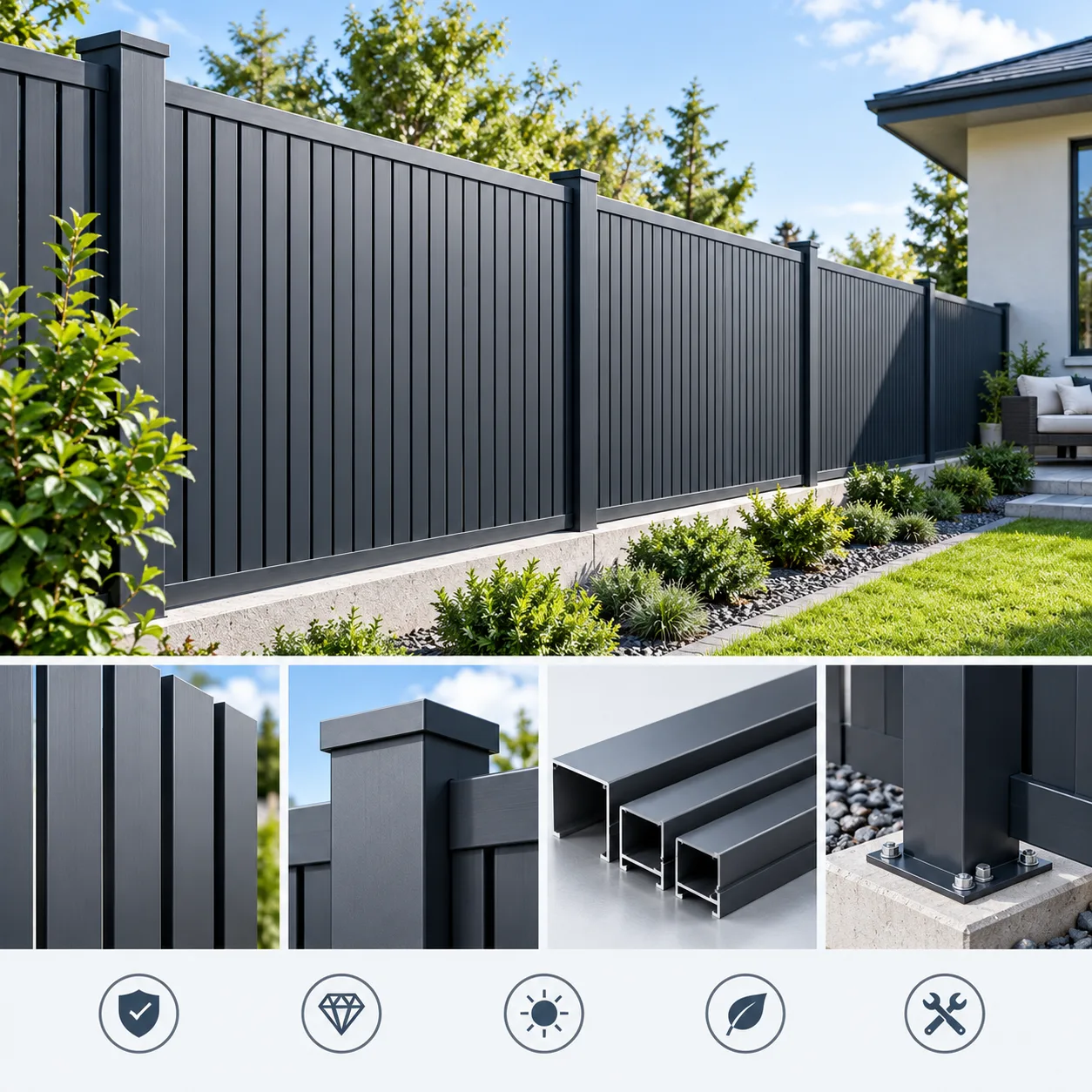
A vertical aluminum privacy fence is a high-performance perimeter system built with upright metal slats designed to block sightlines entirely while giving properties a crisp, modern boundary. Unlike traditional chain-link or open-picket systems, these panels utilize tightly fitted or tongue-and-groove vertical extrusions.
Core Components of Vertical Metal Fence Systems
Every vertical slat fence relies on a modular, interlocking framework engineered to withstand environmental stress:
-
- Structural Aluminum Posts: Heavy-gauge upright posts anchored into the ground or surface-mounted to provide primary structural support.
- Top and Bottom Guide Rails: Horizontal load-bearing channels that seat, align, and lock each vertical slat in place.
- Vertical Infill Slats: Solid, extruded aluminum pickets that slide or snap into position to form the main visual barrier.
- Spacer Blocks and Snap-In Covers: Concealed fasteners and spacers that keep slat gaps uniform or fully sealed while hiding mounting hardware.
- Heavy-Duty Post Caps: Protective end closures that stop water infiltration inside post profiles.
Vertical Aluminum Slats vs. Horizontal Boards
| Feature | Vertical Aluminum Slats | Horizontal Board Fencing |
|---|---|---|
| Water Drainage | Excellent (runoff flows downward instantly) | Moderate (water pools along horizontal seams) |
| Sagging Risk | Zero (gravity works with the vertical profile) | Higher (long horizontal spans can sag over time) |
| Climbing Resistance | High (few horizontal footholds) | Lower (rails act as step-ladders) |
| Visual Effect | Adds perceived height to the yard | Adds perceived width and depth |
Vertical layouts shed rain, dirt, and moisture immediately, reducing residue buildup and eliminating the structural sag commonly found on extended horizontal panels.
Why Aluminum Beats Wood, Vinyl, and Composite Materials
When choosing privacy materials, aluminum consistently outperforms traditional options across lifecycle cost, climate tolerance, and structural stability:
-
- Wood: Prone to rot, splintering, fungal decay, and seasonal warping. It demands regular staining or sealing. Aluminum remains completely rot-proof.
- Vinyl (PVC): Vulnerable to cold-weather cracking, high-heat warping, and brittle failure under heavy impacts. Vertical aluminum privacy fence systems retain their shape in extreme temperatures.
- Composite: Extremely heavy, prone to thermal expansion, and often requires dense substructures to stop boards from bending. Aluminum provides high tensile strength at a fraction of the weight.
By switching to architectural-grade powder-coated aluminum, you eliminate ongoing sanding, repainting, and seasonal board replacements for good.
Key Benefits of Installing Vertical Aluminum Fencing
Modern Aesthetics and Total Visual Privacy
Vertical lines draw the eye upward, creating a clean backdrop that makes yards feel larger and more open.
Complete seclusion: Tight-fitting, vertical tongue-and-groove profiles eliminate sightlines completely, keeping your yard hidden from neighbors and street traffic.
Architectural symmetry: The sleek lines of a black vertical slat fencing system pair naturally with contemporary homes, patios, and modern landscape designs.
Weather Resistance and Powder-Coated Durability
Unlike steel or iron, aluminum cannot rust. When treated with an architectural-grade finish, a powder coated aluminum fence stands up to intense sun, persistent rain, and freeze-thaw cycles without chipping, peeling, or corroding. It creates an impermeable barrier against rot and insect infestations that destroy organic fencing over time.
Zero Maintenance Requirements
Staining, sanding, and sealing lumber every two years drains both time and budget. With vertical aluminum panels, upkeep is virtually zero:
No repainting or chemical sealing required.
Rinses clean with a standard garden hose.
Impermeable to moisture, preventing boards from bowing, shrinking, or cracking.
To evaluate how these long-term labor savings stack up against upfront material expenses, check our aluminum privacy fence cost guide and price estimates.
High Wind-Load Tolerance and Structural Integrity
Wind forces can easily dislodge weak fence panels. Vertical aluminum privacy systems are engineered with interlocking channels and rigid posts anchored in solid concrete. This rigidity allows a properly installed vertical system to act as a dependable, wind resistant privacy fence that holds firm against heavy gusts without warping, rattling, or leaning over time.
| Feature | Vertical Aluminum Privacy Fence | Traditional Wood Fence | Standard Vinyl Fence |
|---|---|---|---|
| Rust & Rot Resistance | Complete (100% rustproof) | Vulnerable to rot and termites | Rot-proof, but can harbor mold |
| Maintenance Needs | Occasional water rinse | Annual sealing or staining | Periodic scrubbing/power-washing |
| UV Resistance | High-grade powder coat won't peel | Fades, splits, and greys | Can turn brittle or yellow in direct sun |
| Structural Rigidity | Heavy-duty extruded metal rails | Warps, twists, and splinters | Expands and sags in high heat |
Design Options, Slat Profiles, and Colors
Slat Gap Spacing: Full Privacy vs. Semi-Privacy
-
- Full Privacy (Tongue-and-Groove): Slats interlock tightly with zero gap. This configuration delivers 100% visual privacy, completely blocking outside sightlines and dampening street noise.
- Semi-Privacy (Shadowbox or Spaced Slats): Slats alternate on either side of the rail or sit with precise 0.5-inch to 1-inch gaps. This layout allows breeze penetration to reduce wind resistance while maintaining perimeter security. Integrating dedicated aluminum fence privacy slats allows you to dial in the exact spacing your yard requires.
Powder-Coated Finishes and Wood-Grain Textures
Every panel is treated with an architectural-grade powder coat designed to resist peeling, chalking, and UV fade.
-
- Textured Matte Black: Our most popular modern finish, offering crisp contrast against green landscapes.
- Charcoal Gray: A contemporary neutral that complements stone, concrete, and modern home siding.
- Architectural Bronze & Clean White: Warm earth tones for classic properties or crisp white for coastal settings.
- Sublimated Wood-Grain: Realistic oak, teak, and walnut patterns bonded directly into the metal. You get the warmth of natural timber without the sanding, oiling, splintering, or insect rot.
Standard Panel Dimensions
| Height | Common Use Cases | Standard Panel Width | Wind & Visual Rating |
|---|---|---|---|
| 4 Feet | Front yards, pool surrounds, patio boundaries | 6 ft or 8 ft sections | Moderate privacy / Code compliant |
| 6 Feet | Standard backyard boundaries, residential privacy | 6 ft or 8 ft sections | 100% backyard privacy / High stability |
| 8 Feet | Commercial perimeters, multi-family screens, noise reduction | 6 ft sections | Maximum privacy / Heavy-duty posts |
Cost Breakdown: Vertical Aluminum Privacy Fence Pricing
Investing in a vertical aluminum privacy fence requires a higher upfront commitment than basic lumber, but it balances out over time. We break down the real numbers behind materials, labor, and long-term value so you can plan your perimeter build without budget surprises.
Average Price Per Linear Foot
Material expenses for vertical slat panels depend primarily on system height (4ft, 6ft, or 8ft) and profile thickness.
-
- Standard panels and posts: Expect to pay between $65 and $115 per linear foot for high-grade aluminum fence privacy slats and structural posts.
- Commercial or heavy-duty profiles: Thicker gauges or engineered wind-rated designs generally range from $110 to $160 per linear foot.
Labor Costs: Professional Installation vs. DIY
| Approach | Typical Cost per Foot | What You Pay For | Best Suited For |
|---|---|---|---|
| Professional Install | $30 – $55 | Post hole augering, laser leveling, concrete mixing, and warranty coverage | Rocky soil, sloped ground, or zero free time |
| DIY Installation | $0 (Labor) | Panel kit purchase, consumable hardware, tool rentals | Flat yards, handy homeowners, budget control |
Long-Term Value: Initial Outlay vs. 20-Year Cost
While pressure-treated pine or cedar costs less on day one, routine upkeep quickly flips the financial math. Wood demands periodic pressure washing, staining, board replacements, and eventual tear-down within 10 to 15 years.
A powder-coated vertical aluminum system does not rot, crack, or require sealant. Over a 20-year span, zero-paint durability saves property owners thousands of dollars in maintenance supplies and contractor bills.
Hidden Costs to Keep in Mind
Before finalizing your budget, account for site-specific extras:
-
- Concrete Footings: Plan on 1.5 to 2 bags of quick-set concrete per post hole ($10–$15 per post).
- Gate Hardware: Walk gates add $250 to $600 each, while double-drive driveway gates with heavy-duty drop rods range from $800 to $2,000+.
- Local Permits and Markings: Municipal building permits generally run between $50 and $200. Always call local utilities before digging.
- Core Drilling: Mounting posts over existing patios or concrete retaining walls requires specialized surface flanges and wedge anchors, adding to tool rental and hardware costs.
For site preparation and step-by-step assembly advice, review our installation and maintenance guidelines before setting your posts.
Step-by-Step Vertical Aluminum Fence Installation Guide
Installing a vertical aluminum privacy fence is a straightforward project when you follow a methodical process. Whether you are using a DIY aluminum fence kit or building out custom sections, getting your layout square and your posts anchored correctly ensures a clean, rattle-free build that stands up to severe weather.
Tools and Safety Gear Required Before Starting
Before unboxing panels and posts, gather these essential job-site tools:
-
- Safety gear: Work gloves, wrap-around eye protection, and steel-toe boots.
- Layout tools: String line, line level, wooden stakes, measuring tape, and marking paint.
- Digging & concrete gear: Post hole digger or mechanical auger, shovel, wheelbarrow or mixing tub, and a post level.
- Fastening & cutting tools: Cordless impact driver, hex head drivers, rubber mallet, torpedo level, and a chop saw equipped with a non-ferrous carbide metal cutting blade.
Measuring, Property Line Layout, and Marking Post Holes
Accurate layout prevents costly repositioning later:
-
- Locate boundaries: Confirm your legal boundary pins and verify local setback rules. Call local utility locators before driving any stakes.
- Run reference lines: Drive stakes beyond the fence corners and run tight mason line along the perimeter to establish true, straight reference lines.
- Mark post spacing: Measure on-center distances based on your vertical slat fence panel widths. Mark each hole location precisely on the ground with marking spray, factoring in post widths and gate openings.
Digging Post Holes and Pouring Concrete for Wind Resistance
To achieve a truly wind resistant privacy fence, footings must handle high lateral loads:
-
- Hole depth and diameter: Dig post holes 10 to 12 inches wide. Extend the depth to at least 30 to 36 inches, or beneath the local frost line to prevent ground heaving.
- Base drainage: Pour 4 to 6 inches of crushed gravel into the bottom of each hole for proper drainage.
- Concrete pour: Mix high-strength structural concrete to a firm, workable consistency. Fill the hole around the post, tamping down to eliminate air pockets, and crown the concrete surface slightly above grade to shed standing water away from the metal.
Setting Upright Posts and Leveling Structural Rails
-
- Set and plumb posts: Insert the upright aluminum posts into the wet concrete. Check all four sides with a post level to maintain vertical alignment, bracing them with scrap lumber while the concrete cures for 24 to 48 hours.
- Mount horizontal rails: Once posts are solid, attach the bottom structural channel between posts. Ensure it sits level and clears the soil line by 2 to 3 inches.
- Fasten top rails: Align and mount the upper receiver channels using color-matched, self-tapping stainless screws to create the rigid framework for the infill.
Inserting Vertical Pickets, Snap-In Slats, and Spacer Channels
Modern metal privacy fencing relies on tight, interlocking profiles for seamless coverage:
-
- Slide first board: Insert the starting slat flush against the post channel. Check for vertical plumb.
- Lock the assembly: Interlock tongue and groove aluminum slats sequentially across the frame, pressing them firmly into place. If using open slat profiles, insert engineered locking spacer channels between pickets to maintain consistent gaps.
- Secure the top cap: Snap or fasten the top structural rail cap over the vertical pickets to lock every component firmly into position, preventing rattle during heavy wind gusts.
Installing Matching Aluminum Privacy Gates and Heavy-Duty Latches
Complete your perimeter with a secure, sagging-free entry point:
-
- Hang the gate leaf: Position aluminum gate kits within the designated opening, maintaining a uniform 1/2-inch to 3/4-inch clearance gap on hinge and latch sides. Use shims beneath the gate to hold proper ground height during mounting.
- Mount heavy-duty hardware: Fasten heavy-duty, multi-adjustable ball-bearing hinges directly to the structural gate post using robust fasteners.
- Align latches and stops: Install a self-latching magnetic or mechanical gravity latch on the strike post. Add an integrated drop rod on double gates to secure the leaves firmly into the driveway or walkway surface.
Maintenance, Cleaning, and Longevity Tips for Your Vertical Aluminum Privacy Fence
Routine Cleaning with Mild Soap and Water
Dust, pollen, and airborne grit naturally collect on outdoor surfaces. We recommend washing down your panels once or twice a year using basic household supplies:
-
- Rinse thoroughly: Spray down the slats using a standard garden hose to dislodge loose debris. Avoid using high-pressure power washers at close range to protect the coating.
- Wash gently: Mix warm water with a mild, pH-neutral liquid dish soap. Wipe down the vertical slats and posts with a soft microfiber cloth or a non-abrasive car wash sponge.
- Final rinse: Rinse away all residual suds with clean water and let the fence air dry, or wipe dry with a clean microfiber towel to prevent spotting.
- What to avoid: Never use acetone, scouring pads, bleach, or solvent-based degreasers, as these degrade the protective powder coat.
Preventing Hard Water Stains and Clearing Ground Contact
Minerals and organic debris are the main culprits behind surface blemishes on metal perimeter boundaries:
-
- Redirect sprinkler heads: Hard well water or municipal irrigation containing high mineral content leaves white calcium deposits on dark finishes. Aim sprinkler nozzles away from your aluminum privacy fence panels to prevent chalky buildup.
- Maintain bottom clearance: Keep garden mulch, decomposing leaves, and wet soil cleared away from the bottom horizontal rail. While high-grade powder coated aluminum fence sections will not rot or rust, trapped moisture and fertilizer runoff can cause dulling along the baseline over extended periods.
Repairing Scratches on Powder-Coated Aluminum Surfaces
If yard equipment or stray tools scuff a slat, touch up the surface promptly to preserve its sleek appearance:
-
- Clean the scratch: Wipe the damaged spot with isopropyl alcohol to clear away grease, dirt, and wax.
- Smooth edges: For deeper gouges with raised edges, gently smooth the perimeter with fine 400-grit sandpaper without rubbing the surrounding healthy finish.
- Apply touch-up paint: Use a manufacturer-matched acrylic enamel touch-up pen or fine artist brush to fill in the groove. Apply light coats rather than one heavy blob to blend seamlessly with the factory matte or textured finish.
Frequently Asked Questions About Vertical Aluminum Privacy Fencing
Do vertical aluminum fences bend or rattle in heavy windstorms?
No. High-grade systems are engineered with interlocking channels and rigid extruded profiles rather than flimsy sheet metal. When our vertical slats are seated within reinforced structural rails, they form a unified, rigid barrier. We design the posts and tongue-and-groove connections to withstand heavy wind loads without bending, buckling, or making annoying rattling noises during high-wind events.
Can I install a vertical aluminum fence on an existing concrete patio or retaining wall?
Yes, you can easily secure them to solid masonry. Instead of digging post holes into the soil, you use surface-mount base flanges anchored directly into the slab or wall using heavy-duty stainless steel wedge anchors. Our modular aluminum privacy fence panels install cleanly across level concrete patios, pool surrounds, and retaining walls while maintaining structural stability.
How does aluminum compare to vinyl fencing in high-temperature zones?
Aluminum significantly outperforms vinyl when the mercury climbs:
No Warping or Sagging: Vinyl softens and expands under high heat, which causes boards to bow out of their tracks. Extruded aluminum remains rigid and retains its exact shape.
No Brittleness: Sun exposure causes vinyl plasticizers to degrade over time, leading to cracking. Aluminum remains structurally sound regardless of heat cycles.
Thermal Stability: Even a dark-toned black aluminum privacy fence holds up against intense solar exposure without softening or distorting.
Will vertical aluminum fences fade or peel under direct UV exposure?
They will not peel or blister. Standard paint applied to wood or steel chips away, but our vertical aluminum systems utilize architectural-grade powder coating baked onto pre-treated metal. This electrostatically applied finish creates a durable barrier that resists chalking, UV fading, and flaking even under continuous, direct sunlight.
Are vertical aluminum panels pet-safe and secure against climbing?
Yes. The vertical slat orientation naturally eliminates the horizontal footholds found on traditional board-on-board or chain-link fences, preventing dogs and intruders from gaining climbing traction. Additionally, the bottom structural rails run flush along the grade line, eliminating gaps so small pets cannot burrow underneath or get their paws trapped.